Area charts in the visualization editor
An area chart plots data points connected by lines and fills the region below each line. Use an area chart to show volume and composition over time. Stack multiple series to see how each category contributes to the total.
Creating an area chart
The following examples build on each other, starting with a basic chart and adding complexity. Before you begin, complete the prerequisites.
Basic area chart
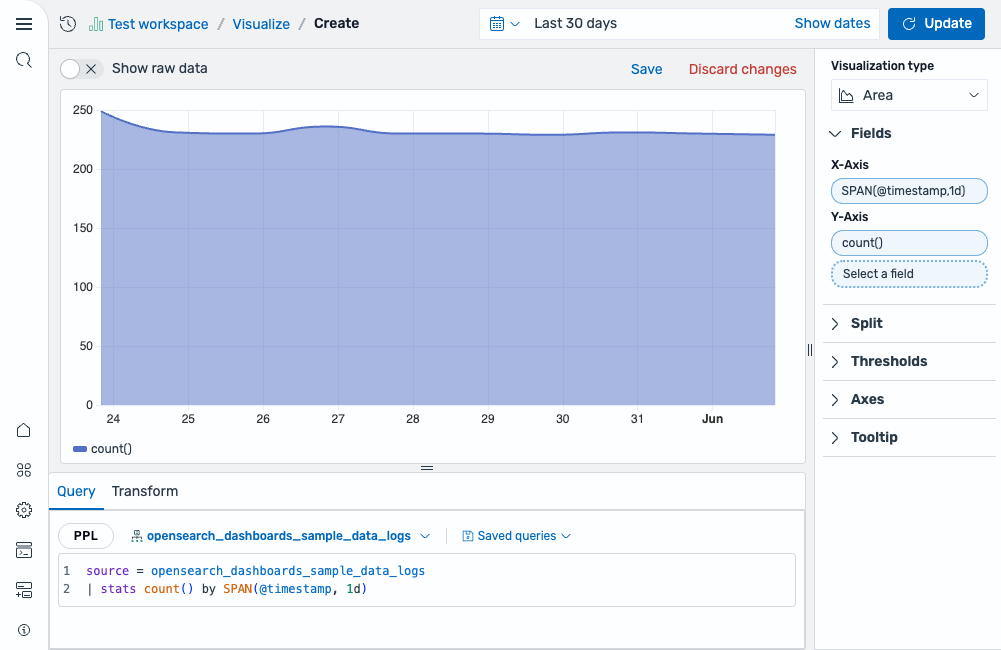
Start with an aggregation query that counts events over time:
source = opensearch_dashboards_sample_data_logs | stats count() by SPAN(@timestamp, 1d)
After running this query, the visualization editor automatically maps the fields:
- The X-Axis displays the
SPAN(@timestamp, 1d)field. - The Y-Axis displays the
count()field.
The result is a single filled area showing the event count per day, as shown in the following image.
Stacked area chart
Add a third dimension to your query to split the data into multiple stacked series by category:
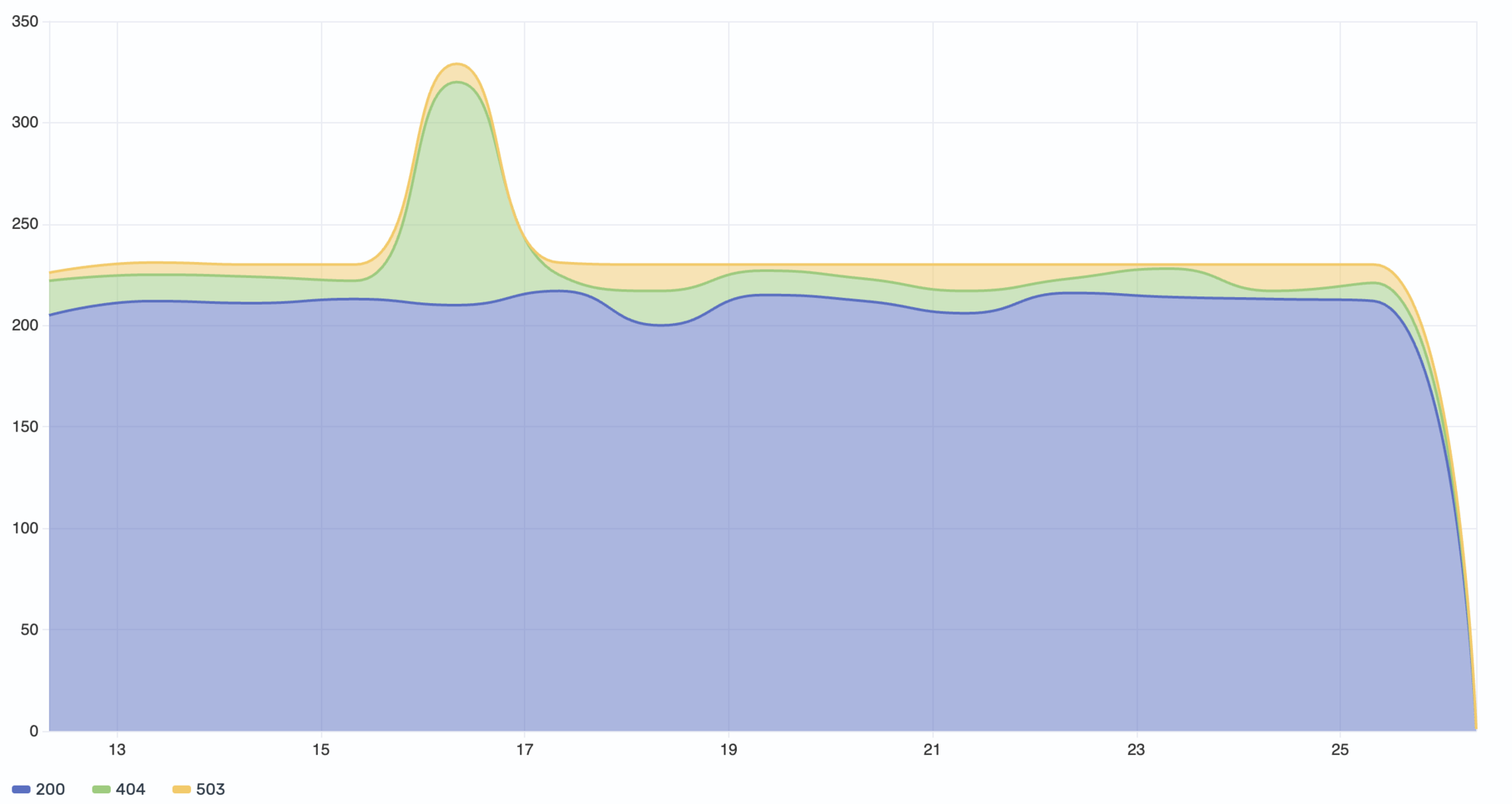
source = opensearch_dashboards_sample_data_logs | stats count() by SPAN(@timestamp, 1d), response
This query groups the count by both time and the response field (HTTP status codes). Select response as the Color field to render a separate stacked area for each status code value (for example, 200, 404, 503).
The result is a stacked area chart that displays each HTTP response code in a distinct color. The chart stacks the areas on top of each other, showing both individual category volumes and the total across all categories, as shown in the following image.
Configuring an area chart
You can configure the following settings in the configuration panel.
Fields
In the Fields section, configure the fields displayed on each axis.
| Field | Description |
|---|---|
| X-Axis | Select a date or numeric field for the horizontal axis that defines the buckets along which data is plotted (for example, SPAN(@timestamp, 1d)). |
| Y-Axis | Select one or more numeric fields to plot as separate areas. When multiple fields are selected, each renders as its own area layer. |
| Color | Select a categorical field to split the data into multiple stacked series, each rendered in a different color. For example, use a response status code field to display separate stacked areas for each HTTP status code. |
Split
In the Split by dropdown list, select a field to split the chart into separate elements by value. For more information, see Split.
Area
The following settings control the area fill, line style, and value display.
| Setting | Description |
|---|---|
| Stack | Controls how multiple series are displayed. None overlays the series without stacking. Stack adds series values together. Percentage stacks series as percentages of the total. |
| Fill opacity | Sets the opacity of the filled area below the line. |
| Gradient mode | Controls the fill gradient. None uses a solid fill. Opacity fades the fill toward the baseline. Hue uses a lighter color toward the baseline. |
| Line style | Controls whether the chart displays lines with points (Default), lines only (Line only), or points only (Dots only). |
| Line dash style | Sets the line pattern to Solid, Dashed, or Dotted. |
| Interpolation | Determines how points are connected. Straight draws direct lines between points. Smooth applies a curve. Stepped creates a staircase pattern. |
| Line width | Sets the thickness of the line in pixels. Supports values in the 1–10 range. |
| Show values | Shows value labels on the chart. |
| Show current time marker | Shows a vertical marker for the current time. This setting is available only when the X-axis uses a date field. |
Thresholds
For information about configuring thresholds, see Thresholds.
Standard options
For information about configuring units, unit suffixes, decimal precision, and minimum and maximum values, see Standard options.
Axes
The X-axis and Y-axis share the same configuration options. For more information, see Axes.
Legend
For information about configuring the legend, see Legend.
Tooltip
Toggle the Show tooltip selector to enable or disable tooltips.